
Industrial-IT-OT--Icon_White_Vector2

OT Systems & Industrial Network Engineering

Build a Reliable, Secure Foundation for Plantwide Operations

 
2026-02-03-OT-Network-Design

Manufacturing systems depend on more than controllers, instrumentation, and production equipment. Industrial networks, servers, virtual machines, firewalls, data centers, backups, and remote-access systems all affect whether production technology performs reliably and can be supported over its full lifecycle.

Cybertrol Engineering designs, modernizes, and supports operational technology infrastructure for industrial environments. Our OT Systems engineers work closely with plant engineering, operations, automation, corporate IT, and cybersecurity teams to improve infrastructure without losing sight of production availability.

Our work begins by documenting what exists, understanding how the plant operates, and identifying the infrastructure risks that could affect reliability, cybersecurity, maintainability, or future expansion.

What Are OT Systems?

Operational technology (OT) systems are the networks, computing platforms, software infrastructure, and security controls that connect, host, monitor, and protect industrial applications.

Unlike conventional enterprise infrastructure, OT systems directly support physical production processes. Maintenance windows may be limited, equipment lifecycles may extend for decades, and an infrastructure failure may stop production rather than simply interrupt an office application.

A plant’s OT environment may support:

PLCs, distributed control systems, and machine controllers

HMI and SCADA systems

Manufacturing historians and reporting platforms

MES and production applications

Industrial servers and virtual machines

Managed industrial switches and wireless infrastructure

Industrial firewalls and demilitarized zones

Remote-access and support systems

Backup, recovery, patching, and monitoring tools

When Does an OT Environment Need Attention?

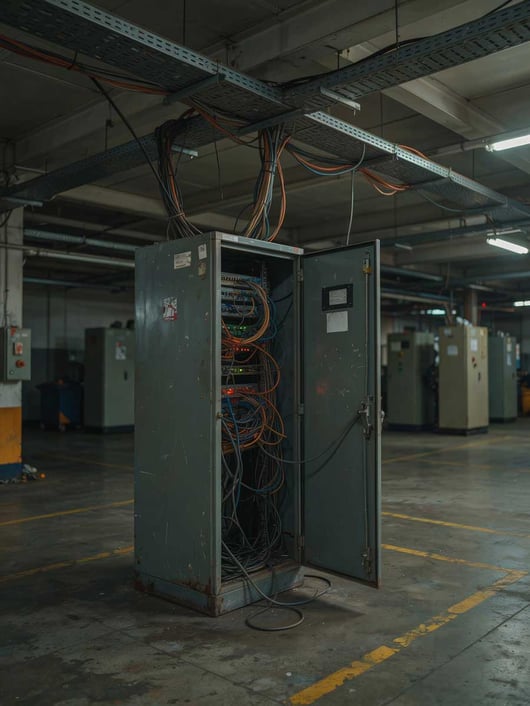
OT infrastructure often develops incrementally as equipment, production lines, software platforms, and reporting requirements are added. Over time, that growth can create an environment that is difficult to understand, troubleshoot, secure, or expand.

These conditions do not always require a complete infrastructure replacement. They do require an accurate understanding of the current environment and a prioritized plan for reducing operational and cybersecurity risk.

Common indicators include:
Network diagrams and device inventories are incomplete or outdated.

Unmanaged switches limit visibility into faults and communications.

Switches are daisy-chained without a defined network topology.

IT and OT systems communicate through undocumented or uncontrolled pathways.

Multiple systems use inconsistent or conflicting IP-addressing conventions.

Servers, switches, operating systems, or firmware are approaching end of support.

Configuration files and virtual machines are not backed up consistently.

Remote access depends on shared accounts or direct connections.

Network or server problems are discovered only after production is affected.

New SCADA, MES, historian, or reporting initiatives are constrained by existing infrastructure.
When-Does-an-OT-Environment-Need-Attention-Web

OT Network Assessments Start with the Current State

An effective OT modernization plan cannot be developed from a generic reference architecture alone. It must account for the plant’s actual equipment, network topology, application dependencies, operating requirements, and production constraints.

Cybertrol’s OT network assessments begin with available customer documentation, switch configurations, network information, and infrastructure records. Engineering review is followed by onsite verification when required to confirm assumptions, inspect physical conditions, and identify undocumented dependencies.

Findings are evaluated in the context of recognized industrial architecture and cybersecurity practices, including the Purdue Model, Converged Plantwide Ethernet guidance, ISA/IEC 62443 principles, CISA guidance, and other standards appropriate to the environment.

The result is a documented current state and a prioritized remediation roadmap based on production risk, cybersecurity exposure, network performance, infrastructure supportability, and future business requirements.

An OT network assessment may examine:

Physical and logical network diagrams

VLAN and IP-addressing structures

Switch configurations and firmware

Spanning-tree and loop-prevention settings

Trunking, port assignments, and unused-port practices

MDF and IDF locations

Fiber and copper cabling paths

Redundant network and power connections

Server, virtualization, and storage infrastructure

Backup and disaster recovery practices

Remote-access methods

IT/OT communication pathways

Unsupported or end-of-life assets

Existing monitoring and configuration-management tools

IT/OT Convergence Does Not Mean Connecting Everything

Manufacturers increasingly need information to move between plant-floor and business systems. Production data may support scheduling, quality, inventory, maintenance, traceability, reporting, and other enterprise processes.

That exchange should not require direct or unrestricted access between the corporate network and the control environment.

A well-designed IT/OT architecture uses controlled communication pathways that may include:

  • Separate enterprise and manufacturing zones

  • VLAN segmentation within the OT environment

  • Industrial firewalls between network zones

  • An industrial demilitarized zone

  • Jump hosts for authorized access

  • Defined firewall rules

  • User authentication and multifactor authentication

  • Monitored remote-access sessions

  • Shared services positioned outside the control zone

The objective is not isolation for its own sake. It is to permit the required data and support functions while limiting unnecessary exposure and preventing business-network traffic from moving directly into control networks.

Cybertrol works with clients’ IT and OT groups to define these boundaries, communication requirements, security controls, and ownership responsibilities.

IT-OT-Convergence-Cybersecurity-Expert-Insights-Cybertrol

Industrial Network Design Must Address
More Than Connectivity

A device communicating successfully today does not necessarily mean that the network is resilient, maintainable, or prepared for expansion.

Industrial network design requires coordinated decisions across the physical and logical infrastructure.
Topology Icon Black

Network Topology & Redundancy

Where production requirements justify it, network design may include redundant paths, resilient network protocols, redundant core infrastructure, and direct connections between distribution locations.

Replacing long daisy chains with a defined star or redundant topology can make faults easier to isolate and reduce the number of downstream devices affected by a single connection failure.

VLAN Icon Black

VLANs & Network Segmentation

VLANs can separate devices and traffic by production area, system type, function, or risk level. Effective segmentation can improve manageability, reduce broadcast traffic, support future expansion, and help enforce communication boundaries.

VLANs are one component of segmentation. Connections between security zones may also require routing controls, access rules, and industrial firewalls.

IP Address Icon Black

Structured IP Addressing

A structured IP-addressing strategy helps engineers understand where devices belong, identify conflicts, support network address translation where required, and maintain consistent standards across production areas.


Infrastructure Icon Black

Physical Infrastructure

Network reliability also depends on the condition and layout of fiber, copper cabling, patch panels, cabinets, MDFs, IDFs, power supplies, and environmental controls. Logical network improvements cannot compensate for damaged cabling, poor cabinet conditions, or a single unprotected power source.

Why Managed Industrial Switches Matter

Unmanaged switches may provide basic connectivity, but they offer limited visibility into what is happening on the network. This limitation becomes increasingly important as the facility grows. Without configuration access and diagnostics, troubleshooting often depends on physical inspection, cable tracing, and trial-and-error replacement.

Managed industrial switches make the network more supportable. Cybertrol can assess existing switch infrastructure, recommend a target architecture, configure replacement hardware, manage firmware upgrades, and document the resulting network.

Managed industrial switches allow engineers to:
Review port status and communication behavior

Configure and enforce VLANs

Implement loop-prevention and resilient network protocols

Disable unused ports

Standardize port configurations

Monitor switch health

Back up device configurations

Diagnose faults more efficiently

Integrate network equipment into centralized monitoring tools
Modern-Data-Center-with-Servers-and-Network-Cables-

Industrial Data Centers & Virtualized Infrastructure

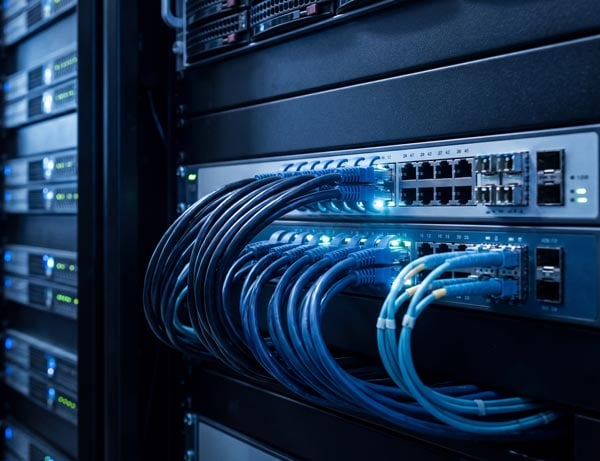
Industrial applications increasingly depend on centralized server and virtualization platforms. These environments may host HMI and SCADA servers, historians, engineering tools, thin-client management, reporting applications, manufacturing software, domain services, and backup systems.

Cybertrol designs and implements industrial computing environments around the availability, lifecycle, compatibility, and support requirements of manufacturing applications.

Whenever practical, systems can be assembled, configured, and validated before they are deployed at the plant. This reduces the amount of configuration required during the production cutover and creates an opportunity to verify application, network, and infrastructure dependencies in advance.

Cybertrol designs and implements industrial computing environments that may include:
  • Physical host servers

  • Hypervisors and virtual machines

  • Network-attached storage

  • Server and application redundancy

  • Thin-client infrastructure

  • Industrial data center networks

  • Backup and recovery platforms

  • UPS monitoring

  • Patch and update management

  • Centralized infrastructure monitoring

Backup & Disaster Recovery Are Not the Same

A backup confirms that data, a virtual machine, or a device configuration was copied. A disaster recovery strategy defines how the required systems will be restored, in what order, by whom, and within what operational constraints.

Having backup files does not ensure that a plant can recover quickly from hardware failure, ransomware, configuration loss, or a server outage. Recovery planning must consider application dependencies, licensing, authentication, replacement hardware, network configurations, and the sequence in which systems must return to service.

Cybertrol can help manufacturers centralize backups, document recovery requirements, and reduce dependence on individual engineers or undocumented restoration procedures.

An OT recovery plan may need to account for:
Virtual machines and host configurations

Server operating systems

SCADA and HMI applications

Historian and production databases

Switch configurations

Firewall configurations

Network-management systems

Application licenses

Domain and authentication services

Local backup storage

Offsite backup storage

Replacement hardware availability

Recovery priorities and dependencies

Restoration roles and responsibilities

image of a white quotation mark

"I have worked with Cybertrol for more than ten years because of their technical expertise. The breadth of their experience is wider than other integrators. Having expertise in computer science, networking and controls, gives them a broader base of knowledge to draw from when solving problems. Their ability to develop custom solutions is probably their strongest suit. On top of that, they don’t miss dates. They get it done."

Supervisor of Critical Applications | Large Oil and Gas Industry Provider

Patching & Lifecycle Management Must Be Planned Around Production

Industrial patching cannot always follow the same schedule used for office computers. Updates may affect control-system applications, device compatibility, vendor support, cybersecurity controls, and production availability.

OT updates should be evaluated, scheduled, documented, and aligned with available production windows. Testing may be required before deployment when compatibility or operational risk is uncertain.

A coordinated OT maintenance strategy may include:

Windows Server updates

Hypervisor updates

Industrial switch firmware

Firewall firmware

Server and storage firmware

UPS firmware

Rockwell Automation software patches

ThinManager updates

Backup software updates

Antivirus and endpoint-security updates

Review of operating-system and application logs

Server and virtual-machine resource reviews

Backup-job verification

End-of-sale and end-of-life planning

Scheduled maintenance reporting

Centralized Monitoring Improves Response & Troubleshooting

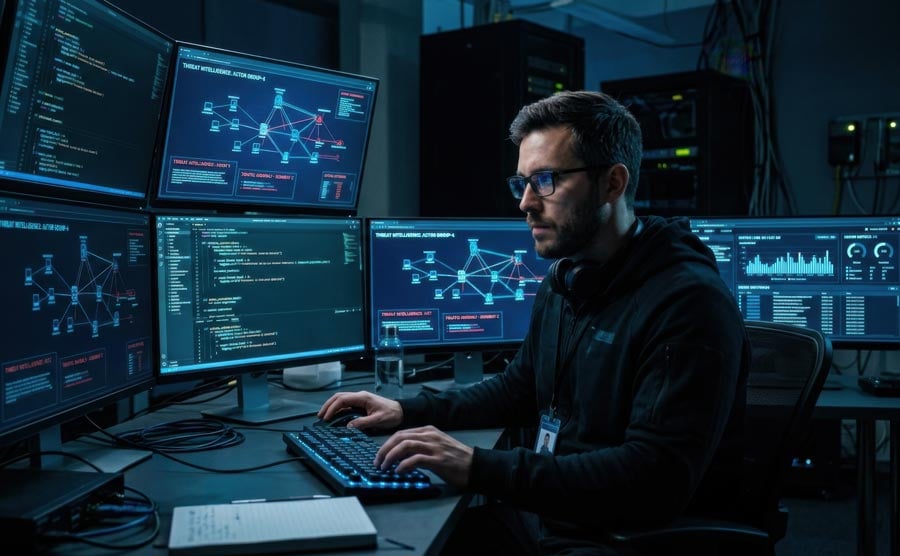
Many OT infrastructure problems begin as intermittent or localized conditions. A failing switch port, high device temperature, UPS alarm, storage limitation, network loop, missed backup, or server resource issue may develop before production is visibly affected.

Centralized monitoring does not eliminate failures. It provides earlier visibility and better diagnostic information so plant and support teams can identify developing problems, determine where a fault originated, and respond before a localized issue affects a larger portion of the operation.
Cybersecurity-Analyst-Monitoring-Network-Web-2
Centralized OT monitoring may include:
  • Managed switches

  • Industrial firewalls

  • Physical servers

  • Virtual machines

  • Storage systems

  • UPS units

  • MDF and IDF cabinets

  • Critical applications

  • Network device temperatures

  • Server resource usage

  • Communication status

  • Backup-job status

  • System alarms and event logs

Secure Remote Access for Industrial Support

Remote access can improve support response, reduce travel requirements, and provide specialized engineers with system access when assistance is needed. It can also introduce significant risk when access pathways are not controlled.

The appropriate remote-access architecture depends on the facility’s security requirements, corporate standards, application environment, support model, and production risk.

Cybertrol designs remote-access solutions that provide controlled pathways into the OT environment without directly exposing the control network.


A secure industrial remote-access architecture may include:

An industrial firewall

An industrial demilitarized zone (iDMZ)

A managed jump host

Individual user accounts

Multifactor authentication

Role-based permissions

Time-limited or approval-based access

Defined firewall rules

Session logging and monitoring

Separation between third-party access and the control network

Documented access ownership and support procedures

Modernizing Brownfield OT Infrastructure

Brownfield facilities rarely begin with a clean or fully documented architecture. Plants may contain multiple generations of control platforms, networks installed by different suppliers, legacy protocols, unsupported operating systems, limited cabinet space, and few available shutdown windows. A practical modernization program addresses these conditions incrementally. Immediate risks can be corrected while creating a structured path toward a more consistent and supportable plantwide architecture.

Cybertrol uses a defined project methodology to coordinate current-state assessment, future-state design, validation, implementation, and long-term support.

1

Discuss

Understand the production process, business objectives, operational pain points, IT requirements, maintenance capabilities, and acceptable risk.

2

Define

Document the current environment, establish project boundaries, identify dependencies, and define the required future-state performance and security objectives.

3

Design

Develop the network, server, virtualization, cybersecurity, backup, and recovery architecture. Plan migration phases and cutover requirements.

4

Develop

Configure infrastructure, virtual machines, switches, firewalls, monitoring tools, and supporting documentation.

5

Demonstrate

Validate configurations, communication pathways, failover behavior, backups, and system dependencies before deployment when practical.

6

Deploy

Sequence onsite work around production requirements and complete installation, migration, testing, and commissioning.

7

Deliver

Provide updated documentation, configuration records, recovery information, training, support planning, and recommendations for the next lifecycle phase.

OT Infrastructure Must Support the Manufacturing Applications Above It

Industrial networks and data centers are not isolated technology projects. Their design affects the performance and availability of every application they support.

Cybertrol’s multidisciplinary engineering capabilities allow OT infrastructure decisions to be coordinated with control-system architecture, manufacturing applications, cybersecurity requirements, and production support.

This coordination is particularly important during plant expansions, control-system migrations, SCADA standardization, MES deployments, historian projects, and reporting initiatives. Infrastructure limitations discovered late in these projects can affect schedule, cost, testing, and startup risk.

OT infrastructure may support:

PLC and control-system architecture

HMI and SCADA systems

Plantwide distributed control systems

Manufacturing historians

Production reporting

MES applications

Batch systems

Industrial data platforms

Remote engineering support

Enterprise system integration

Plantwide system standardization

OT Systems Services

Cybertrol provides OT Systems engineering across the infrastructure lifecycle.

Assessments & Consulting

  • OT network assessments

  • Current-state documentation

  • Network architecture reviews

  • Cybersecurity and segmentation reviews

  • Troubleshooting and diagnostics

  • Modernization roadmaps

  • Lifecycle and end-of-support planning

Industrial Networking

  • Network architecture and design

  • Managed switch configuration

  • Switch replacement and firmware upgrades

  • VLAN and IP-addressing design

  • Redundant topology design

  • Industrial wireless infrastructure

  • MDF and IDF planning

  • Network cabinet and cabling coordination

Firewalls & Industrial DMZs

  • Industrial firewall configuration

  • Industrial DMZ architecture

  • Remote VPN access

  • Multifactor authentication

  • Jump-host architecture

  • Controlled IT/OT communication

Key elements of Cybertrol’s approach include:

Assessment-first engineering based on documented current conditions

Automation, OT Systems, digital manufacturing, and information systems expertise

Coordination with clients’ IT and OT groups

Brownfield integration and phased modernization experience

Production risk identification and mitigation

Infrastructure designed around manufacturing applications

In-house configuration and validation where practical

Project, service, and long-term support

Discuss → Define → Design → Develop → Demonstrate → Deploy → Deliver methodology

Why Work with Cybertrol for OT Systems?

OT infrastructure decisions affect controls, manufacturing applications, cybersecurity, production availability, and long-term support. Addressing them effectively requires more than enterprise IT experience or control-system programming alone.

Cybertrol brings together OT infrastructure, automation, information systems, cybersecurity, digital manufacturing, and project implementation disciplines. This allows network, server, virtualization, and security decisions to be evaluated in the context of the production systems they support.

Cybertrol can remain involved beyond the initial project through scheduled maintenance, remote support, monitoring, backup management, troubleshooting, upgrades, and lifecycle planning.


Plantwide Automation

Integrated control systems designed for reliable, scalable plant operations.

Digital Manufacturing

MES, reporting, traceability, dashboards, and production information systems.

24/7 Service & Support

Dedicated engineering support, troubleshooting, and lifecycle services.

OT Systems FAQs

What is the difference between IT and OT?

Information technology supports business systems such as email, finance, enterprise applications, corporate data centers, and cloud services. Operational technology connects, controls, monitors, and protects physical manufacturing processes and equipment.

The two environments increasingly exchange information, but they have different availability requirements, equipment lifecycles, maintenance constraints, security priorities, and operational consequences.

What is included in an OT network assessment?

An OT network assessment may include a review of network diagrams, switches, firewalls, IP addresses, VLANs, cabling, MDFs and IDFs, servers, virtualization platforms, backups, remote-access pathways, lifecycle status, and current IT/OT boundaries.

The process typically combines documentation and configuration review with onsite verification. The final deliverable identifies current conditions, areas of risk, and prioritized recommendations.

Does IT/OT convergence require combining the networks?

No. IT/OT convergence means enabling the information exchange and coordinated processes the business requires. It does not require placing enterprise and control systems on a single flat network.

Controlled convergence typically uses segmentation, industrial firewalls, an industrial DMZ, jump hosts, and defined communication rules.

What is an industrial DMZ?

An industrial demilitarized zone is a network segment positioned between enterprise and manufacturing environments. It can host shared services, jump hosts, data-transfer functions, patch-management tools, and other resources that must communicate with both environments.

Connections from the enterprise network should terminate in the DMZ rather than communicating directly with the control network.

Why should a manufacturer replace unmanaged switches?

Unmanaged switches provide basic connectivity but limited diagnostics, configuration control, segmentation, or loop prevention.

Managed switches allow engineers to configure VLANs, monitor ports, implement resilient protocols, disable unused connections, back up configurations, and troubleshoot communication problems more effectively.

Can an OT network be upgraded without shutting down the entire plant?

Many upgrades can be phased by production area, network segment, cabinet, server group, or scheduled outage. The feasibility depends on the existing topology, available redundancy, equipment dependencies, and production schedule.

Current-state documentation and cutover planning are essential because undocumented connections or single points of failure may limit the available migration options.

What is the difference between backup and disaster recovery?

A backup is a stored copy of data, a virtual machine, or a device configuration. Disaster recovery is the documented process for restoring the required systems, applications, and communications after a failure.

A recovery strategy identifies restoration order, dependencies, responsibilities, replacement hardware requirements, recovery locations, and acceptable downtime.

How often should OT systems be patched?

There is no universal schedule for every OT environment. Patch frequency should consider cybersecurity risk, vendor guidance, application compatibility, production availability, system criticality, and corporate policy.

Updates should be reviewed and coordinated rather than applied automatically to critical production infrastructure without understanding their potential impact.

What should be monitored in an OT environment?

Monitoring priorities commonly include managed switches, industrial firewalls, servers, virtual machines, storage capacity, UPS systems, network cabinets, critical applications, device temperatures, resource usage, and backup-job status.

The appropriate scope depends on the architecture and the production consequences of each component failing.

When should OT infrastructure be reviewed?

A review is particularly valuable when a plant is preparing for a control-system migration, MES deployment, SCADA standardization, network expansion, cybersecurity initiative, facility acquisition, major equipment installation, or replacement of unsupported infrastructure.

An assessment may also be warranted when the facility experiences recurring communications problems, lacks accurate documentation, or depends on aging network and server platforms.

What is the difference between IT and OT?

What is the difference between IT and OT?

Information technology supports business systems such as email, finance, enterprise applications, corporate data centers, and cloud services. Operational technology connects, controls, monitors, and protects physical manufacturing processes and equipment.

The two environments increasingly exchange information, but they have different availability requirements, equipment lifecycles, maintenance constraints, security priorities, and operational consequences.

What is included in an OT network assessment?

What is included in an OT network assessment?

An OT network assessment may include a review of network diagrams, switches, firewalls, IP addresses, VLANs, cabling, MDFs and IDFs, servers, virtualization platforms, backups, remote-access pathways, lifecycle status, and current IT/OT boundaries.

The process typically combines documentation and configuration review with onsite verification. The final deliverable identifies current conditions, areas of risk, and prioritized recommendations.

Does IT/OT convergence require combining the networks?

Does IT/OT convergence require combining the networks?

No. IT/OT convergence means enabling the information exchange and coordinated processes the business requires. It does not require placing enterprise and control systems on a single flat network.

Controlled convergence typically uses segmentation, industrial firewalls, an industrial DMZ, jump hosts, and defined communication rules.

What is an industrial DMZ?

What is an industrial DMZ?

An industrial demilitarized zone is a network segment positioned between enterprise and manufacturing environments. It can host shared services, jump hosts, data-transfer functions, patch-management tools, and other resources that must communicate with both environments.

Connections from the enterprise network should terminate in the DMZ rather than communicating directly with the control network.

Why should a manufacturer replace unmanaged switches?

Why should a manufacturer replace unmanaged switches?

Unmanaged switches provide basic connectivity but limited diagnostics, configuration control, segmentation, or loop prevention.

Managed switches allow engineers to configure VLANs, monitor ports, implement resilient protocols, disable unused connections, back up configurations, and troubleshoot communication problems more effectively.

Can an OT network be upgraded without shutting down the entire plant?

Can an OT network be upgraded without shutting down the entire plant?

Many upgrades can be phased by production area, network segment, cabinet, server group, or scheduled outage. The feasibility depends on the existing topology, available redundancy, equipment dependencies, and production schedule.

Current-state documentation and cutover planning are essential because undocumented connections or single points of failure may limit the available migration options.

What is the difference between backup and disaster recovery?

What is the difference between backup and disaster recovery?

A backup is a stored copy of data, a virtual machine, or a device configuration. Disaster recovery is the documented process for restoring the required systems, applications, and communications after a failure.

A recovery strategy identifies restoration order, dependencies, responsibilities, replacement hardware requirements, recovery locations, and acceptable downtime.

How often should OT systems be patched?

How often should OT systems be patched?

There is no universal schedule for every OT environment. Patch frequency should consider cybersecurity risk, vendor guidance, application compatibility, production availability, system criticality, and corporate policy.

Updates should be reviewed and coordinated rather than applied automatically to critical production infrastructure without understanding their potential impact.

What should be monitored in an OT environment?

What should be monitored in an OT environment?

Monitoring priorities commonly include managed switches, industrial firewalls, servers, virtual machines, storage capacity, UPS systems, network cabinets, critical applications, device temperatures, resource usage, and backup-job status.

The appropriate scope depends on the architecture and the production consequences of each component failing.

When should OT infrastructure be reviewed?

When should OT infrastructure be reviewed?

A review is particularly valuable when a plant is preparing for a control-system migration, MES deployment, SCADA standardization, network expansion, cybersecurity initiative, facility acquisition, major equipment installation, or replacement of unsupported infrastructure.

An assessment may also be warranted when the facility experiences recurring communications problems, lacks accurate documentation, or depends on aging network and server platforms.

Ready to Strengthen Your OT Infrastructure?

Whether you are assessing an existing network, planning a modernization, improving IT/OT segmentation, or building a more supportable OT environment, Cybertrol can help you define the current state and develop a practical path forward.

Related Articles